

ADEME: pre-screening aid applications to free up caseworkers
We designed an agent for ADEME that pre-analyses the eligibility and completeness of aid applications, to relieve the caseworkers who review them. The Dis-ADEME challenge jury named it the winner, and the agency then asked us to take it into production. Here is how we worked — and what this method would look like for you.
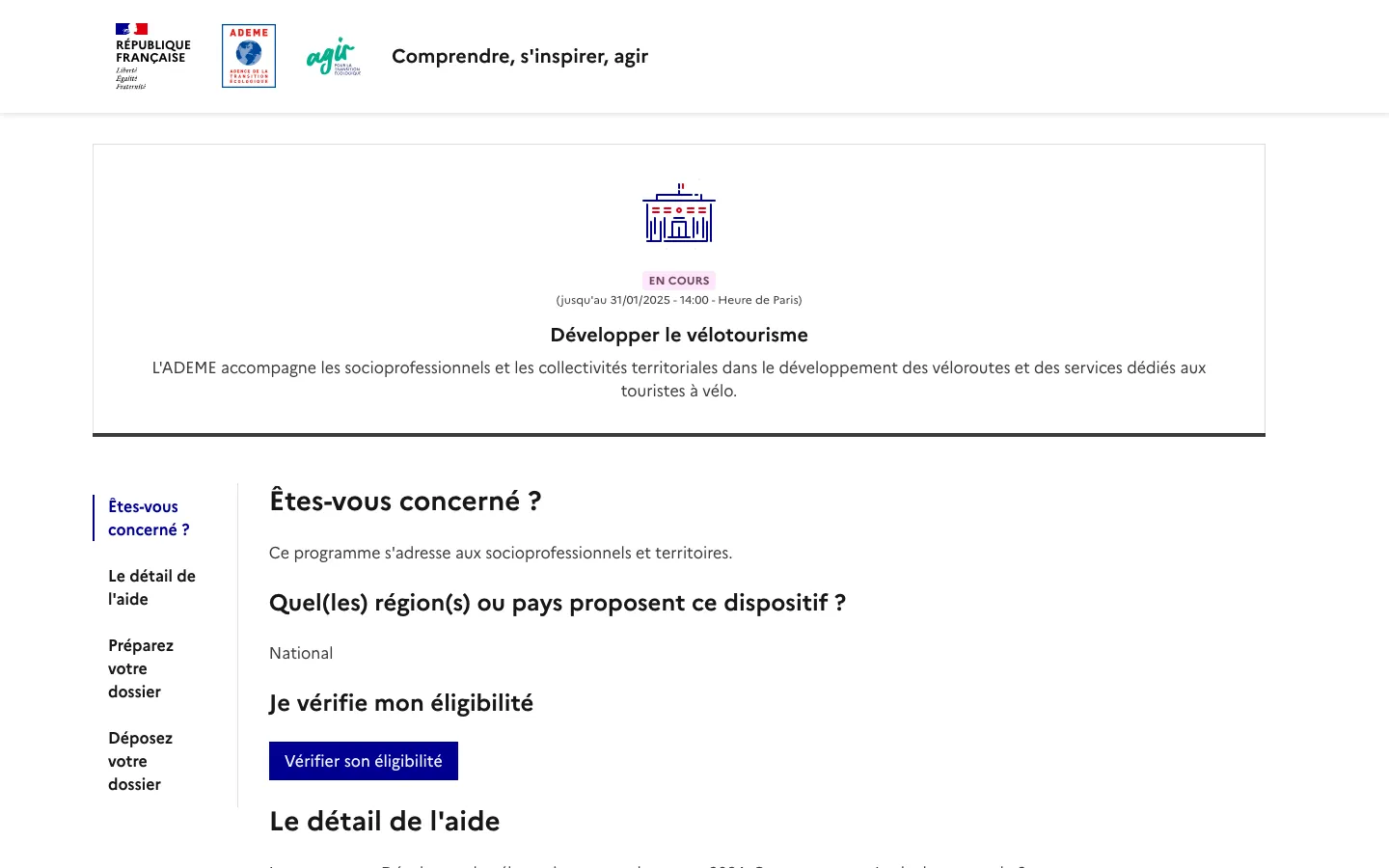
A problem we had experienced ourselves
Like thousands of SMEs, we once applied for a public aid scheme — and missed out. Not because the project was weak, but because an eligibility criterion had escaped us, buried in the scheme's conditions.
What we had experienced as an applicant, ADEME experiences at scale on the reviewing side. Some of the applications it receives are ineligible or incomplete, and every one of them takes up a caseworker's time. It is the same problem, seen from both sides of the counter.
Every application, even one bound to be rejected, follows the same path. A caseworker opens it, checks the scheme's criteria, verifies the documents, then writes a response. Multiplied by the volume of files, this manual triage consumes precious time. That time is lost to the projects that deserve real scrutiny, and to the applicants who could use support.
The challenge, and what we made of it
ADEME, the French ecological transition agency, launched its Dis-ADEME challenge to improve the handling of its aid schemes through AI. We already knew this problem: we had lived it.
In three weeks, the team designed an agent that pre-analyses aid applications: the company's eligibility and the completeness of the file. The team brought together Hichem Ammar-Boudjelal (CEO), Florian Gadal (CTO), Nicolas Albiges (data scientist) and Christian Tchouaffé (data analyst). Not a mock-up: a working prototype, tested on around a hundred cases and live at ademe.dpliance.com.
The jury named DPLIANCE winner of the challenge.
Assisted pre-screening, explainable and traceable
The principle fits in one sentence: structure the scheme's criteria, then check each application against facts rather than declarations. The agent verifies eligibility from the company's real data, notably its APE activity code retrieved through the SIRENE registry API. This replaces a declarative questionnaire. It then checks that the file is complete, document by document.
Every application comes out with an explicit status. Every conclusion stays explainable and traceable: the caseworker knows why a file was flagged, and can verify each step of the reasoning. Transparency wins over the black box: a public service must be able to justify every rejection, on the basis of an explainable score.
The agent prepares each file: it pre-screens, and the decision stays in the caseworker's hands. It is a design choice, not a technical limitation. The benefit works on both sides of the counter: caseworkers receive pre-screened files and focus on the applications that deserve their time. Applicants, in turn, can check their eligibility before submitting. "Our goal was to create a screening agent that supports applicants," as Christian Tchouaffé put it in Le7.info.
The screening flow, in four steps
-
Application submitted
Aid request and supporting documents.
-
Criteria analysis
Eligibility checked through the SIRENE API, completeness verified document by document.
-
Explainable statuses
Every conclusion is traced and verifiable by the caseworker.
-
Caseworker decision
The final decision stays human, on a pre-screened file.
From the award to integration
Winning a challenge is one thing; equipping a public agency is another. Building it into ADEME's systems is work of a different kind from the prototype: making every check reliable, fitting into existing systems, preparing day-to-day monitoring.
It is the part of the work we care about most. A prototype proves an idea works; it is in production, used every day, monitored and maintained over time, that a solution truly delivers. That is our method on every project: we operate what we build.
What this method would look like for you
ADEME's pattern shows up everywhere a back office processes files: insurers and mutual funds handling reimbursement claims, local authorities awarding grants, banks reviewing loan applications. Each time, the same mechanics: known criteria, documents to check. And teams spending their time on files that should have been screened out much earlier.
The approach that worked for ADEME is the one we apply to every project. We start from a concrete problem and build a prototype on your real data, with success criteria defined together. We then take the solution to production, to operate it day to day. The same safeguards apply: explainable conclusions, full traceability, and the decision staying in your teams' hands.
If your teams spend time checking files, sorting requests or verifying documents, AI can often pre-screen that work. The starting point stays the same: a conversation with an engineer to scope your need. First results then arrive on your data, within a few weeks.
The questions we get about this case
Does the AI decide in the caseworker's place?
No. The agent pre-screens: it checks eligibility and completeness, explains its conclusions and makes them traceable. The decision stays human: a design choice, not a technical limitation. That is what makes the solution acceptable for a public service.
How does the agent verify eligibility?
Against the company's real data rather than declarations: the APE activity code, for instance, is retrieved through the SIRENE registry API. The scheme's criteria are structured into verifiable rules, and every check is logged — the caseworker can retrace the full reasoning.
How long does a project like this really take?
The challenge format compressed the prototype into three weeks, and that is exactly what a challenge is for. Real life is slower. Allow a few weeks of prototyping on your own data. Then allow three to six months to reach production inside your tools, depending on how many systems have to talk to each other. Industrialising the ADEME agent is taking considerably longer than winning the challenge did — and that is the normal order of things.
Is this kind of agent GDPR-compliant?
Compliance is built into the architecture: sovereign hosting, data minimisation, traceability of decisions. It is our home ground: our GDPR compliance software equips more than 500 organisations. The same standard applies under Law 25 in Quebec.
Let's talk about your project.
In practice: an engineer takes your call directly for a thirty-minute video conversation, with no sales pitch and no commitment on your part. You leave with a frank opinion: what this method would deliver on your case, and the realistic timeline to get there. Write to us: a reply within 24 business hours, from a human.